South coastTenerife South airport (64 m), the nearest 30-year station to Costa Adeje and Los Cristianos
March
Afternoons
23°
most days 21–26°
22° or warmer on 65% of days
Nights
15°
most nights 13–17°
Sea
19°
19–20° in most years
Sunshine
8.3h a day
of 12.0 h of daylight, 69%
sunset 19:15, same clock as the UK
Wet days
1.4days
83% of weeks stay dry
any rain at all: 2.2 days
Drag across the year, tap a month, or use ← →
- Day to night
- Afternoon
- Night
- Sea
- Sunshine vs daylight
- Wet days
Afternoons on the south coast average 23° in March, 1° warmer than in February. Nights are around 15°. Expect about 8.3 hours of sunshine a day, 69% of the daylight. Rain is unusual, with about one wet day in an average March. Across 1991–2020, 83% of weeks had no wet day at all. The sea is at its coolest, around 19°. Evenings are cool enough for a light jacket.
Afternoons in March across the island
Will it rain on my holiday?
Based on every one-week stay starting within a week of your date, on the south coast, in each year from 1991 to 2020.
83% of one-week stays starting around 15 March had no wet day at all. On average, rain of 1 mm or more fell on 0.3 of the 7 days.
30 real Marches on the south coast
12 of 30 Marches had no wet day at all. The wettest had 7 (1993 and 1996).
From the beach to Teide in March
Afternoons at Izaña (2,371 m) are 13° cooler than on the south coast in March. La Laguna gets 45% of the possible sunshine, while Izaña, usually above the cloud that gathers on the north slopes, gets 81%.
Colour = typical afternoon temperature at that height in March: from 1° at the summit to 23° on the coast (4 stations; above Izaña estimated at −6.5° per km).
Real terrain along straight legs: sea → Tenerife South airport → Teide summit → Izaña → Los Rodeos → Santa Cruz → sea (80 km). Heights are exaggerated about 6 times. Elevation: AWS Terrain Tiles — SRTM terrain data courtesy of the U.S. Geological Survey; may include EU-DEM, produced using Copernicus data.
The year at a glance on the south coast
Month by month on the south coast
| Month | Afternoon °C | Night °C | Sea °C | Sun, h a day | Sunset | 22°+ days | Wet days | Dry weeks |
|---|---|---|---|---|---|---|---|---|
| January | 22° | 15° | 20° | 7.1 | 18:32 | 48% | 1.6 | 78% |
| February | 22° | 15° | 19° | 7.7 | 18:57 | 46% | 1.9 | 73% |
| March | 23° | 15° | 19° | 8.3 | 19:15 | 65% | 1.4 | 83% |
| April | 23° | 16° | 20° | 8.3 | 20:32 | 81% | 1.0 | 82% |
| May | 24° | 17° | 20° | 8.9 | 20:49 | 94% | 0.2 | 98% |
| June | 26° | 19° | 21° | 9.5 | 21:04 | 100% | 0.1 | 98% |
| July | 28° | 20° | 22° | 10.6 | 21:05 | 100% | 0.0 | 100% |
| August | 29° | 21° | 23° | 10.0 | 20:45 | 100% | 0.3 | 94% |
| September | 28° | 21° | 24° | 8.3 | 20:12 | 100% | 0.6 | 90% |
| October | 27° | 20° | 24° | 7.6 | 19:37 | 100% | 2.1 | 63% |
| November | 25° | 18° | 23° | 7.1 | 18:14 | 97% | 1.5 | 83% |
| December | 23° | 16° | 21° | 6.9 | 18:13 | 78% | 3.3 | 66% |
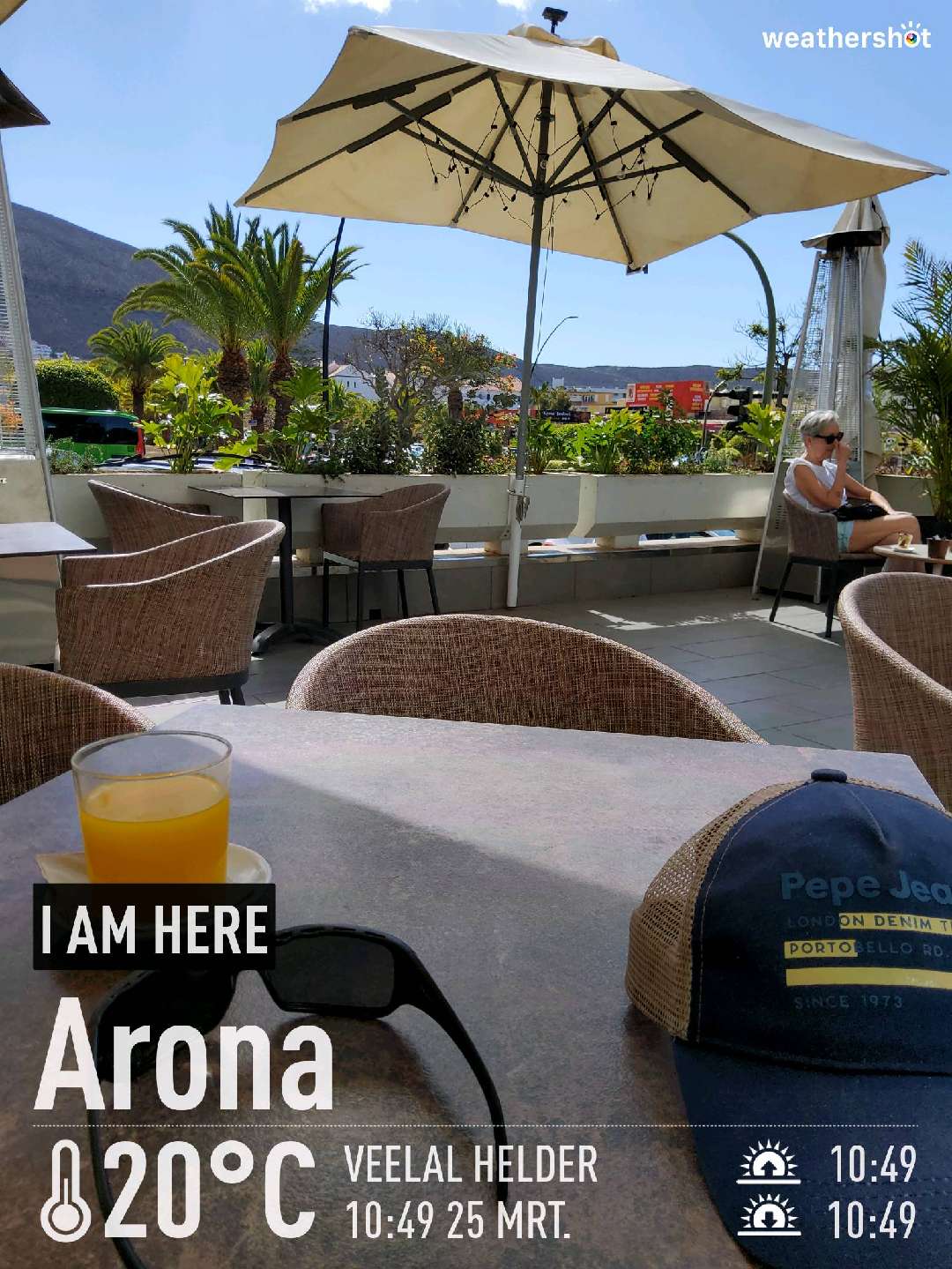
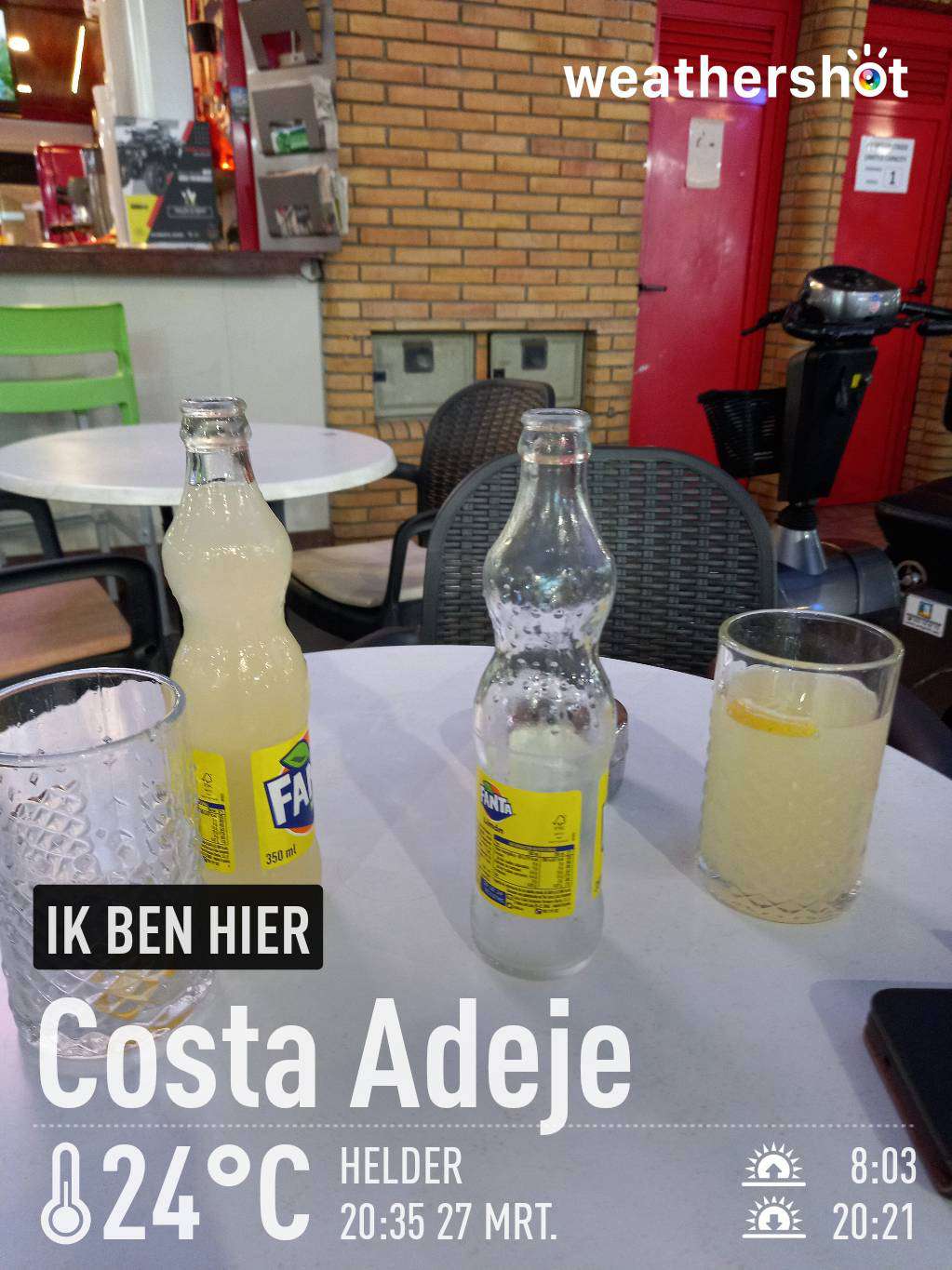
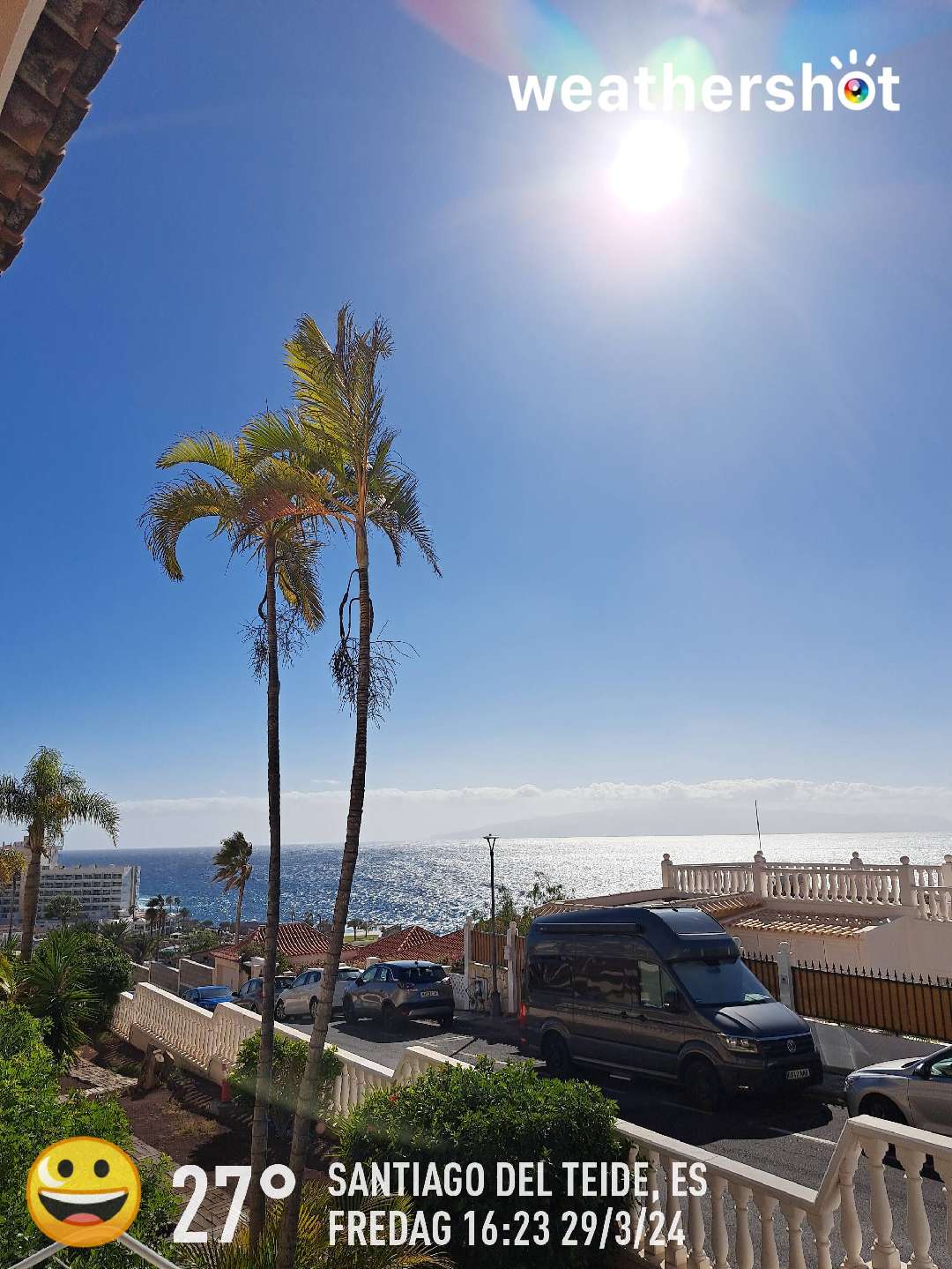
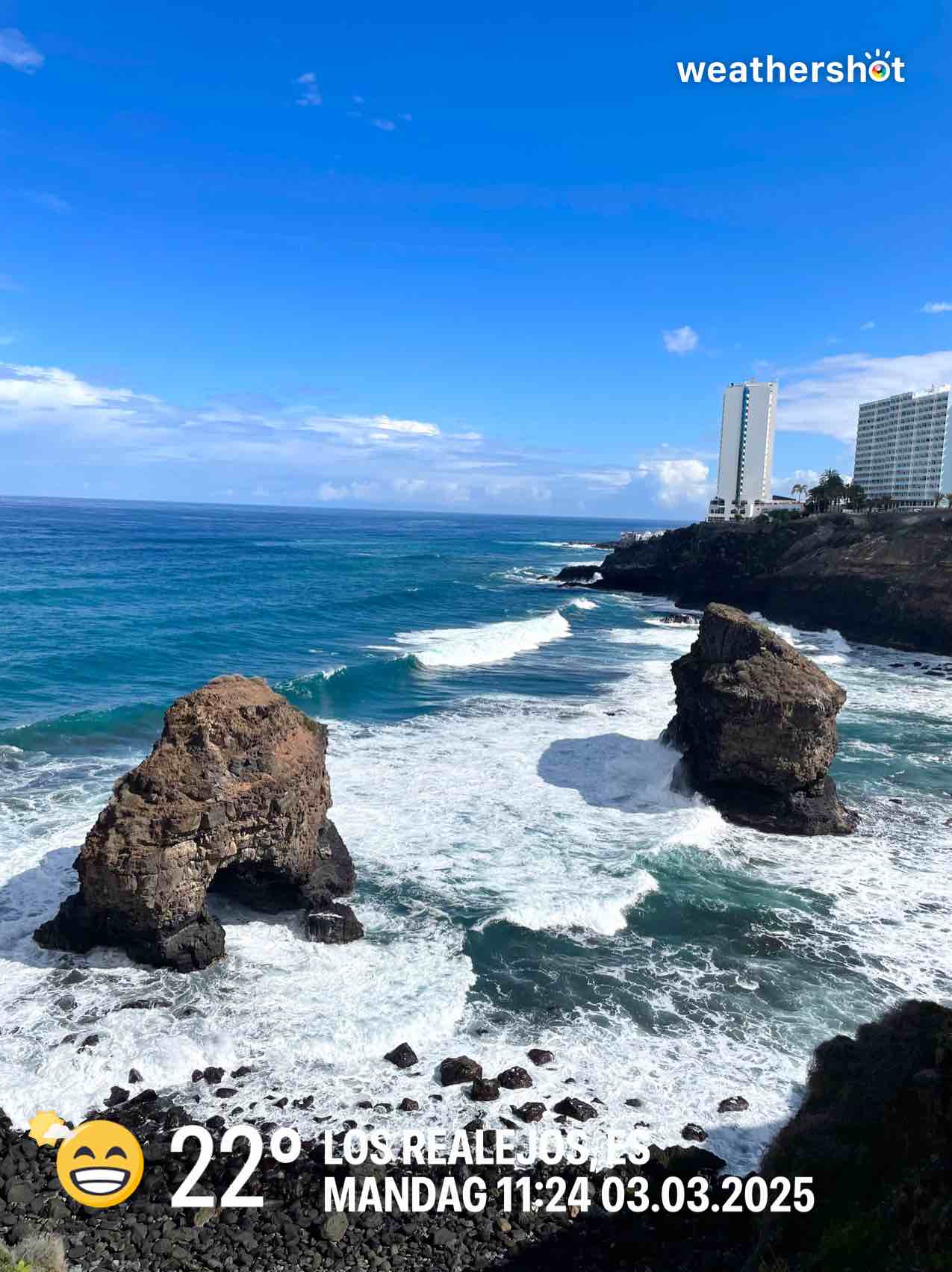
Tenerife in March — real photos
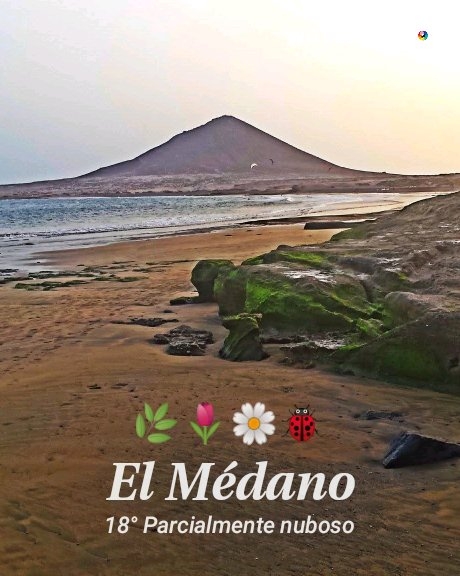
From the Weathershot community, taken in March. Each photo carries the temperature at the moment it was taken.

Where these numbers come from
Sources
- Temperatures, rain and frost: GHCN-Daily records 1991–2020 for the four stations, from NOAA's National Centers for Environmental Information. Averages, ranges and holiday odds all come from these daily records, so they agree with each other.
- Sunshine: WMO Climate Normals 1991–2020 for the same stations.
- Sea temperature: NOAA Coral Reef Watch CoralTemp v3.1, monthly means 1991–2020 on a 5 km grid, just offshore.
- Daylight and sunset: astronomical calculation for the 15th of each month. The Canary Islands keep the same clock as the UK all year.
| Place | Station | Height | IDs |
|---|---|---|---|
| South coast | Tenerife South airport (TFS) | 64 m | WMO 60025 SPE00120476 |
| Santa Cruz | Santa Cruz de Tenerife (city) | 35 m | WMO 60020 SPE00120458 |
| La Laguna | Tenerife North airport, Los Rodeos (TFN) | 632 m | WMO 60015 SPE00120467 |
| Teide | Izaña observatory | 2,371 m | WMO 60010 SP000060010 |
How to read it
- A wet day has 1 mm of rain or more, the standard the WMO and the Met Office use. Any rain at all counts days with 0.1 mm or more, which is why some sites quote more rainy days.
- Most days means the middle 80% of daily readings, from the 10th to the 90th percentile.
- A dry week is seven days in a row without a wet day. We count every start date within a week of yours, in each year from 1991 to 2020.
- South-coast figures come from Tenerife South airport, about 15 km east of Los Cristianos and Costa Adeje. The airport sits next to El Médano, one of the windiest spots on the island, so we don't show wind.
- The official WMO normals run warmer than the daily records at the south airport (by 0.1–0.8 °C, most in winter) and in Santa Cruz (by 0.3–0.5 °C). We use the daily records throughout.
- Puerto de la Cruz and the rest of the north coast have no public 30-year station record in these datasets.
- Photos come from the Weathershot community, taken on location in that month in past years; photos from the neighbouring islands are marked “nearby”.